Two childhood passions, twenty planets, one intergalactic criminal and a little BBC BASIC.
Play the game by copying and pasting the text of the above file into the online Owlet BBC BASIC editor
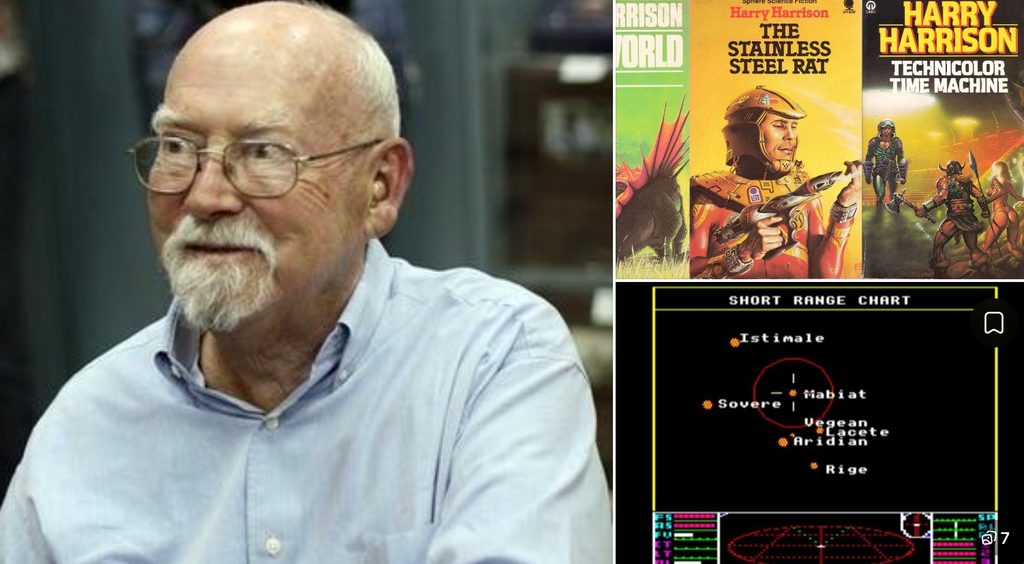
Growing up, one of my favourite science fiction authors was Harry Harrison. Of all his wonderful creations, there was one particular character who made a lasting impression on me: James Bolivar “Slippery Jim” diGriz, otherwise known as the Stainless Steel Rat.
The Stainless Steel Rat books formed an important part of my reading growing up. Jim was fiercely independent, resourceful, optimistic and possessed a wonderful sense of humour about the galaxy and its inhabitants.
Whatever extraordinary predicament he found himself in, there was always another solution, another angle or another opportunity. Preferably one that involved a substantial amount of money.
In some respects, he was a childhood role model for me. Not for his criminal tendencies, I hasten to add, but for his independence of thought, his ability to question authority and his determination to approach life’s challenges with ingenuity and humour.
So, combining my enthusiasm for retro British computing with my love of Harry Harrison’s fiction, I decided to create a new game for the BBC Micro.
The man behind the Rat
Harry Harrison (1925–2012) was a remarkably imaginative and versatile science fiction author. His works included the Deathworld trilogy, Bill, the Galactic Hero, West of Eden and Make Room! Make Room!, which inspired the 1973 film Soylent Green.
The Stainless Steel Rat first appeared in the pages of Astounding Science Fiction in August 1957, with the first novel following in 1961.
Harrison’s stories were often satirical, poking fun at bureaucracy, militarism, political systems and the absurdities of human behaviour. He was also an enthusiastic advocate of Esperanto, which found its way into his fictional universe.
His galaxy was a place where civilisation might have advanced technologically by thousands of years, but humanity had lost none of its peculiarities.
A little inspiration from Elite
The other inspiration for this project was, of course, Elite, the groundbreaking space trading game developed by David Braben and Ian Bell and first published by Acornsoft in 1984.
One aspect of Elite that particularly appealed to me was its galactic chart and planetary selection system.
Choosing your next destination wasn’t simply a matter of travelling from A to B. You had to consider fuel, distance, local economic conditions, political stability and the potential risks and rewards of visiting a particular planetary system.
I wanted to incorporate some of that strategic decision-making into a Stainless Steel Rat game, but with an emphasis on interplanetary crime, evasion and increasingly desperate escapes.
The result is Wanted: The Stainless Steel Rat, a turn-based strategy game written entirely in BBC BASIC.
Welcome to a life of intergalactic crime
You take on the role of Slippery Jim diGriz, with a rather modest 5,000 credits, a partially fuelled spaceship and twenty planetary destinations to explore.
Your objective is simple: accumulate 100,000 credits and retire to a luxury planet.
Unfortunately, Harold Inskipp, head of the Special Corps, is tracking your hyperdrive signature and is determined to bring your criminal career to an abrupt end.
Each planet has its own characteristics, including population, security, wealth and available fuel. You can attempt to rob banks, raid casino vaults or, if you’re feeling particularly ambitious, relieve an entire planetary treasury of its contents.
Naturally, the bigger the potential reward, the greater the risk.
Successful robberies increase your wealth, but they can also increase your Heat level. Allow your notoriety to reach 100% and your career is over.
The planetary black markets offer several useful services:
- Refuelling your spaceship.
- Purchasing increasingly sophisticated false identities.
- Installing an advanced hyperdrive.
- Bribing the local authorities to reduce your Heat level.
There are also unexpected events. Revolutions can reduce planetary security, intercepted transmissions can increase your notoriety, and abandoned fuel supplies can provide a welcome lifeline.
And, naturally, Angelina makes an occasional appearance — usually at some expense to Jim!
A different galaxy every time
One of the most enjoyable additions to the game has been the introduction of procedural galaxy generation.
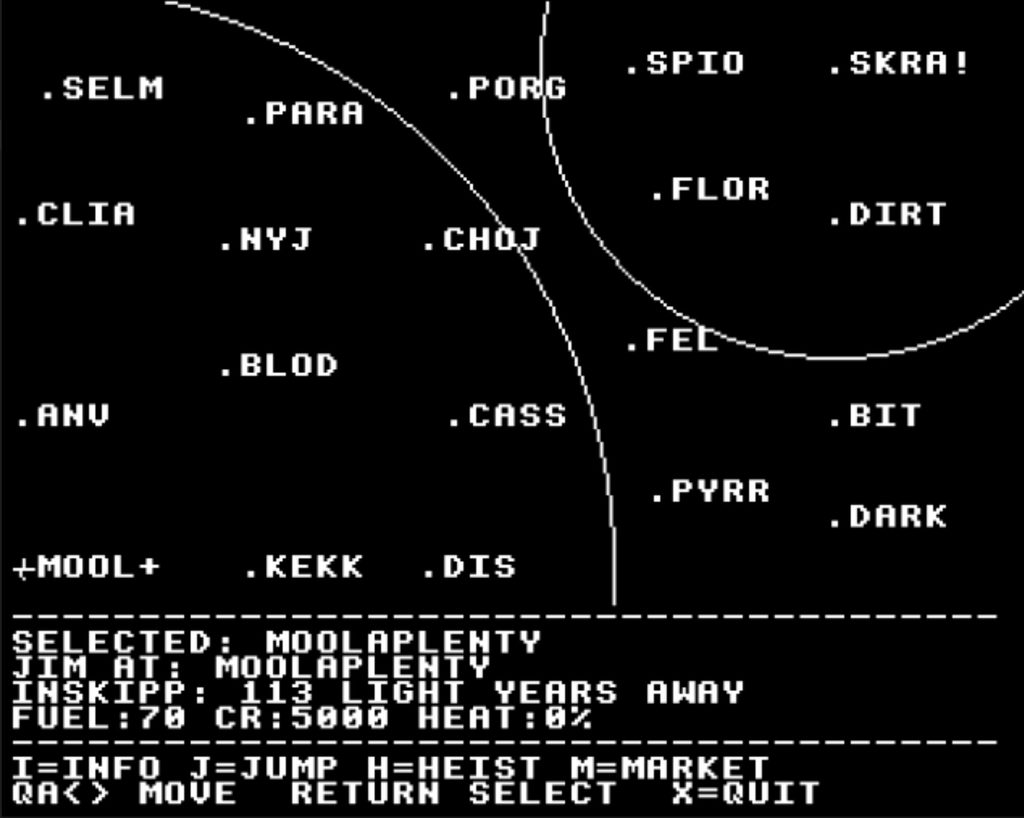
Every new game rearranges the twenty planets into different positions. Jim and Inskipp are initially placed at opposite ends of the map, giving our slippery hero a head start.
The two large circles on the galactic chart represent Jim’s available hyperspace range and Inskipp’s potential travel range.
This makes the map itself an important part of the strategy. A wealthy planet may look like an irresistible target, but will you have enough fuel to escape afterwards? And how close is Inskipp getting?
The latest version even incorporates a moveable targeting crosshair, controlled using the wonderfully traditional Q, A, < and > keys, with RETURN selecting the nearest planet.
It feels very much at home on an eight-bit British computer.
Technical notes
The game has been developed for BBC BASIC Version 2, deliberately working within the limitations of the original BBC Micro architecture.
- Display: MODE 4, 320 × 256 pixels, monochrome.
- Galaxy: 20 planets with procedurally generated positions.
- Navigation: Moveable targeting crosshair using XOR graphics.
- Travel: Distance calculations using Pythagoras’ theorem.
- Artificial intelligence: Inskipp attempts to move closer to Jim within his available hyperspace range.
- Random events: Environmental changes, unexpected encounters and complications.
- Graphics: Hyperspace animation, fuel-range circles and a dedicated status panel.
- Sound and graphics hardware: No additional hardware or external graphics assets required by the program.
One particularly satisfying programming technique is the use of XOR graphics to plot the targeting crosshair. Drawing it a second time restores the original screen contents, allowing the crosshair to move without having to redraw the entire galaxy.
It’s the sort of economical programming technique that was particularly valuable in the days of eight-bit machines.
I’ve also been using ChatGPT as a collaborative programming partner, developing the game iteratively, refining its mechanics, troubleshooting the display and introducing new features.
There is something rather pleasing about using twenty-first-century artificial intelligence to help create a game using a programming language from 1981.
An affectionate tribute
This is an unofficial fan-game project, rather than an attempt to recreate any particular Stainless Steel Rat novel.
I wanted to capture some of the spirit of Harry Harrison’s universe: the sense of adventure, the resourcefulness, the unpredictability and, above all, the fun.
It’s also a game that I would have loved to discover as a type-in listing in the pages of Acorn User or Your Computer magazine back in the 1980s.
More than four decades after the arrival of the BBC Micro, there’s still a great deal of pleasure to be had from typing RUN and watching an entire galaxy spring into existence.
Now, if you’ll excuse me, there’s a planetary treasury that requires my attention.
And Inskipp is only 35 light years away…
| Planet | Literary Origin | Connection to the Story |
|---|---|---|
| Anvhar | Planet of the Damned (1962) | Brion Brandd’s homeworld, characterised by extreme seasonal changes. |
| Cliaand | The Stainless Steel Rat’s Revenge (1970) | An aggressive, militaristic planet engaged in interstellar conquest. |
| Moolaplenty | The Stainless Steel Rat Returns (2010) | The luxurious holiday world where Jim and Angelina enjoy retirement. |
| Bit O’ Heaven | A Stainless Steel Rat Is Born (1985) | Jim’s agricultural homeworld, where his criminal ambitions first develop. |
| Paraiso-Aqui | The Stainless Steel Rat for President (1982) | An apparent paradise ruled by a corrupt dictator. |
| Chojecki | The Stainless Steel Rat Gets Drafted (1987) | A peaceful world threatened by military invasion. |
| Blodgett | The Stainless Steel Rat Wants You! (1978) | A tranquil planet where Jim and Angelina spend time together. |
| Spiovente | Stainless Steel Rat series* | A location associated with Jim’s adventures. |
| Dirt / Earth | The Stainless Steel Rat Saves the World (1972) | Humanity’s long-forgotten homeworld and the destination of Jim’s time-travelling exploits. |
| Floradora | The Stainless Steel Rat Returns (2010) | A potential settlement for Jim’s relatives and their livestock. |
| Kekkonshiki | Stainless Steel Rat series* | A lesser-known location from the Rat’s universe. |
| Skraldespand | Possibly You Can Be the Stainless Steel Rat (1985)* | A possible reference to Harrison’s interactive adventure gamebook. |
| Nyjord | Planet of the Damned (1962) | A neighbouring civilisation threatened by the inhabitants of Dis. |
| Dis | Planet of the Damned (1962) | An inhospitable desert world at the centre of an interplanetary crisis. |
| Selm II | Planet of No Return (1968) | A mysterious planet littered with the remnants of advanced war machines. |
| Porgorstorsaand | Deathworld (1960) | Jason dinAlt’s conservative agricultural homeworld, from which he escapes. |
| Cassylia | Deathworld (1960) | A gambling world where Jason dinAlt undertakes a lucrative casino operation. |
| Pyrrus | Deathworld (1960) | An extraordinarily hostile planet whose wildlife threatens human survival. |
| Felicity | Deathworld 3 (1968) | A dangerous world inhabited by fierce, technologically primitive societies. |
| Darkhan | Deathworld (1960) | A rival world to Cassylia, whose political independence provides an escape opportunity. |
*Some literary references remain provisional and require further verification. The planetary characteristics, economies, security levels and relative positions have been adapted for gameplay rather than attempting to reproduce Harry Harrison’s fictional geography exactly.